The pharmaceutical R&D pipeline faces a glaring paradox: while artificial intelligence can propose hundreds of novel, highly optimized molecular candidates in seconds, testing those molecules still relies on physical wet-lab validation. AI-enabled workflows have compressed computational discovery timelines from five years down to as little as 12–18 months, but the physical bottleneck remains — accessing fast, reliable, and cost-effective wet-lab validation.
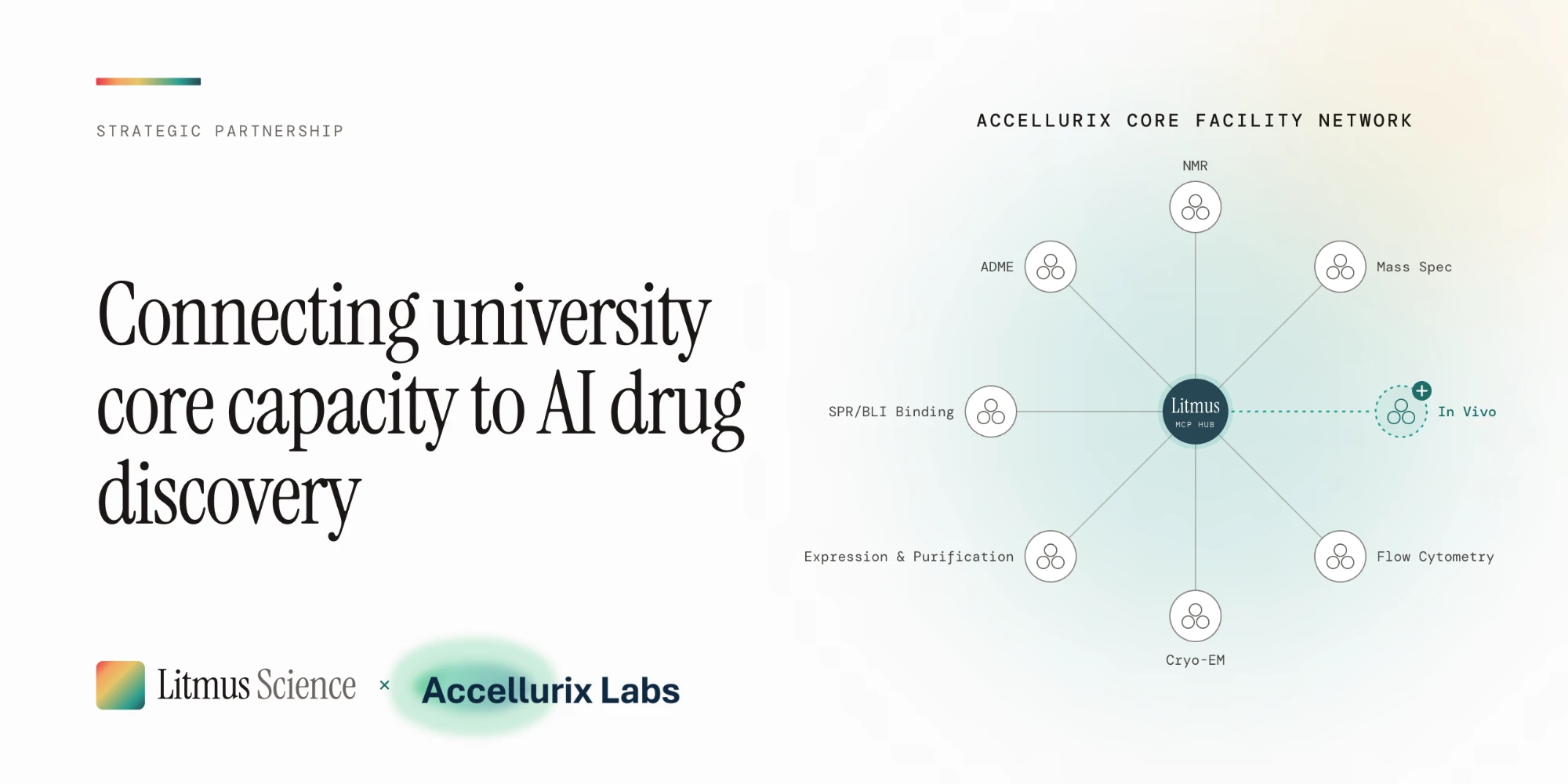
To solve this, Litmus Science and Accellurix Labs have formed a strategic partnership. By combining Litmus's MCP-native execution platform with Accellurix Labs' university core facility network, we are building a seamless highway that connects computational molecular design directly with physical laboratory capacity.
Two Halves of the Same Solution
Connecting computational AI models to physical laboratories requires solving two distinct challenges simultaneously: programmatic assay translation & multi-provider orchestration on one side, and institutional access friction on the other.
| Entity | Role | Core Responsibilities |
|---|---|---|
| Litmus Science | Lab Execution layer for AI driven science |
|
| Accellurix Labs | Institutional Core Facility Gateway |
|
Litmus Science serves as the MCP-Native Execution & Translation Layer. Rather than requiring manual assay configuration, Litmus captures candidate outputs directly from generative models and AI co-scientists via the Model Context Protocol (MCP). It translates heterogeneous computational predictions into standardized, machine-readable assay packages — expression, purification, SPR/BLI binding affinity (KD), and developability screens — and dynamically routes them across a broad provider network encompassing commercial CROs, automated cloud labs, CDMOs, and university core facilities.
Accellurix Labs acts as the Institutional Core Facility Gateway. Founded by a team of scientists and engineers, including a university core facility director, Accellurix Labs manages pre-negotiated master agreements with top-tier research universities, eliminating months of administrative red tape so projects can attach a simple Statement of Work (SOW) and begin execution immediately. Accellurix Labs has developed core facility connections through the support of the Heartland BioWorks Tech Hub, an initiative of the Applied Research Institute (ARI) supported by a $51 million grant from the U.S. Economic Development Administration. Heartland BioWorks is accelerating the growth of America's biotechnology and biomanufacturing industries, and Accellurix Labs advances this mission by connecting innovators to core facility infrastructure. (Learn more about the Heartland BioWorks Tech Hub.)
The Litmus × Accellurix Labs partnership leverages an established foundation in Indiana — drawing on nearly 30 core facilities with specialized capabilities and cutting-edge technologies from universities with reputations for technical excellence.
Together, this partnership creates a closed-loop pipeline:
AI proposes → Litmus ingests via MCP → Litmus helps with Experimental Planning and Quote Generation → Accellurix Labs executes via university cores → Litmus feeds structured data back into the AI model.
Where Academic Cores Differentiate
Litmus Science's routing engine connects to a multi-provider execution ecosystem that includes high-throughput commercial CROs, CDMOs, and automated cloud laboratories. However, for early-stage, non-GLP discovery, incorporating Accellurix Labs' expanding academic core network provides critical advantages that commercial alternatives cannot match:
- Lower Costs for Non-GLP Work — Academic cores operate on non-profit, break-even cost-recovery models, eliminating commercial markups for early-stage screening.
- Direct Access to PhD Domain Experts — Unlike standard CRO assembly lines, academic cores are led by specialized university faculty and scientists who actively consult on protocol customization and troubleshoot complex biological readouts.
- Specialized & Grant-Funded Infrastructure — Cores house high-end instruments, such as ultra-high-field NMR, cryo-EM, and niche disease models, funded by federal research grants that commercial CROs cannot economically justify purchasing.
- Flexible Multi-Lane Routing — While cloud labs excel at automated high-throughput assays and CROs excel at standardized GLP workflows, academic cores fill the vital gap for specialized, low-cost discovery assays.
- IP Protection — Universities within the Accellurix Labs network ensure proprietary information is well protected, and together they have simplified the process for handling IP developed within core facilities.
How the Joint Workflow Operates in Practice
Consider an AI discovery startup validating 50 novel protein variants:
1. Programmatic Ingestion (Litmus)
The biotech's generative AI model outputs 50 candidate variants. Litmus captures the list via MCP, standardizing it into a machine-readable test package (express/purify 50 variants, SPR/BLI binding KD, solubility/aggregation).
2. Multi-Provider Benchmarking (Litmus × Accellurix Labs)
Litmus compares execution options across commercial CROs, Cloud Labs, and Accellurix Labs' academic core network:
| Execution Provider | Price | Turnaround |
|---|---|---|
| Academic Core A (Selected) | $X | 4–6 Weeks |
| Automated Cloud Lab | $Y | 2–3 Weeks |
| Commercial CRO | $Z (1.5x higher) | 3–4 Weeks |
Illustrative example only. The prices and turnaround times shown are hypothetical, not actual quotes.
3. Frictionless Execution & Closed-Loop Feedback
The startup selects Core A for its combination of expert support and lower cost. Accellurix Labs manages SOW attachment, logistics, and sample tracking. Upon assay completion, Litmus ingests structured, machine-readable data back into the AI model to train the next generation of candidates.
Guardrails & Scope
To ensure optimal execution across the network, the partnership maintains clear scope boundaries:
- Non-GLP/GMP Focus for Cores — University cores excel at early discovery, target validation, hit-to-lead, and lead optimization. Regulatory GLP/GMP studies remain routed to accredited commercial CROs/CDMOs.
- Fit-for-Purpose Routing — Litmus does not replace CROs or Cloud Labs; it gives biotechs dynamic visibility across all execution channels so teams can route each experiment to the best option for speed, cost, and complexity.
Join the Active Pilot Program
Litmus Science and Accellurix Labs are running a 60–90 day pilot focused on molecular characterization for proteins, lipids and small molecules, including candidate screening, stability assays, and binding kinetics using techniques such as mass spec, flow cytometry, NMR, microscopy, calorimetry, and bioinformatics.
- Biotech & AI Teams: Evaluate core facilities for your experimental requests.
- Core Directors: Join Accellurix Labs' growing network for commercial project opportunities.
Learn more at litmus.science and accellurixlabs.com.